|
|
|
|
| |
| |
Modern Geophysical Survey Method
We have experienced & qualified Geologists, Groundwater Surveyors, who assist the customer in deciding the bore well point and selection of pumps. Geophysics and Geology, in the past few years, has reached a place of vital importance for the scientific development and protection of the world's precious groundwater supply. Geophysical investigations of the buried strata can be made either from the land surface or in a drilled hole in formation. |
|
|
| |
Hand Augur
Hand augur bore wells are manually drilled tube well which may range from 20 – 200 ft. in depth and 4”- 12” in diameter. Most of the hand bore wells need periodical cleaning/Flushing. Hand Augur suitable for sandy and highly loose formation with probable occurrence in coastal areas where quality of water can be monitored while drilling and representative soil as well as water sample can be obtained to construct effective bore wells. |
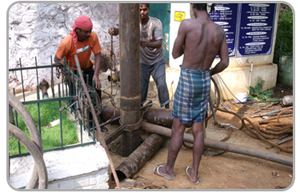 |
|
| |
Calyx
Calyx rigs are used in sedimentary and clayey formation occurring mostly in river Alluvium or river banks for making a large diameter bore well with gravel /graded pebble packing. In this method of Bore well, it takes 2 - 5 days to drill a bore hole but this duration depends on soil formation and level of water. That might be the reason it is so called as “Slow Rig”. This method requires much water rather than other type of bore well method. In Chennai this method are followed at T.Nagar, Ashok Nagar, Vadapalani, Porur, Valasaravakkam, Kodambakkam, K.K.nagar, Egmore, OMR etc |
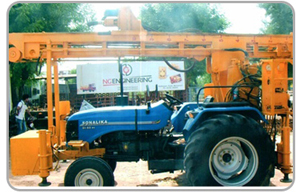 |
|
| |
DTH
DTH: (Down the hole Hammer) Suitable for highly compact sedimentary strata consisting of clay, compact clay, limestone, sandstone and common Gondowana sedimentary rocks up to a dept of 1300 ft. DTH drilling is adopted for drilling through weathered medium and massive hard rock formation rapidly up to 1500ft. In Chennai we found direct rock formation at Velachery, Tambaram, Madipakkam, Medavakkam, Madambakkam, Aavadi, Ambattur, Pallikaranai, OMR etc.
Flushing and cleaning of Bore well
A bore well must be flushed periodically for the best yield and for safety of the bore well. This is because the ground water may change any time. We do flushing and cleaning bore well through high pressure air compressor, which takes raw water, dust, or wastes and decayed particles if any. If we find any decayed particles or animal, we use calcium carbonate in that bore well to kill the germs and bacteria. According to depth we choose our compressor type to cleaning the bore well. |
 |
|
| |
Reconstruction of Collapsed / Damaged and Extension of Bore wells
To improve the borewell source we can extend the depth of the borewell.
Conducting yield test of Bore wells with detailed report
We conduct yield test on bore wells to state the quantity of water that can be utilized per day. The details regarding that will given in a brief report which state water level, yield per hour, yield in normal monsoon and in acute summer . |
|
|
| |
Rainwater Harvesting and Purification System
We follow our traditional method of rain water harvesting i.e., Percolation Method. A percolation pit is a hand bore made in the soil with the help of an augur and filled up with pebbles and river sand on top. A square / circular collection chamber with silt arrester is provided at the top.
kanyakumari.nic.in/rw.html -- LINK |
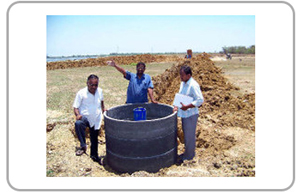 |
|
| |
Water - Testing – parameter analysis
Water testing also handled by us. This is done under the circumstance, while the water color and odor change. After testing the water only we give the solution of flushing & cleaning of bore well or that bore well may be demolished and a new borehole is drilled.
We adopt following analysis :
1) Physical examinations: Color, odor, turbidity, and electrical conductivity, total dissolved solids and suspended solids.
2) Chemical examinations: pH, alkalinity, hardness, calcium, magnesium, sodium, potassium, iron, manganese, ammonia, nitrite, nitrate, chloride, fluoride, sulfate, phosphate, silica, BOD, COD, TKN, oil & grease, aluminum, chromium, arsenic, free chlorine.
3) Bacteriological examination: Standard plate count, total coli form, fecal coli form, fecal streptococci. |
|
|
|
|
|
| |
|
|
|
|
|